
Constitutive Secretion
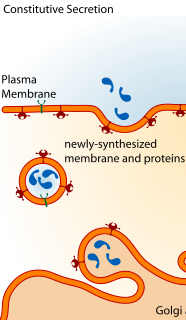
- The constitutive secretory pathway is a continual process that occurs in all cells.
- This pathway uses constitutive vesicles which bud from the trans golgi network (TGN).
- Vesicles fuse as soon as they contact the plasma membrane.
 Functions of the Constitutive Secretory Pathway:
1. Delivery of newly synthesised membrane lipids and proteins to the plasma membrane.
2. Release of newly synthesised soluble proteins to the extracellular space e.g. proteoglycans and glycoproteins which contribute to the formation of the extracellular matrix.
Most cells are polarised, they have apical and basolateral surfaces with varying membrane compositions and extracellular environments, which need to be maintained effectively.
Although the constitutive pathway is classified as an unregulated process, there needs to be a mechanism to ensure that proteins are delivered to the correct plasma membrane domain within polarised cells. This can be achieved in two ways:
Delivery of proteins to the basolateral surface of epithelial cells is dependent on a sorting signal (sequence of amino acids) in the tail of these proteins. This signal is recognised by coat proteins that direct them into veiscles destined for the basolateral membrane.
If an error occurs in the above pathway and proteins are delivered to wrong membrane domain, these can be endocytosed and moved via transcytosis to the correct membrane.
It has been shown that the small GTPase Rab6 is found on the membrane of vesicles of the constitutive pathway. Rab6 and the microtubule plus end directed motor kinesin-1 stimulate the progressive movement of constiutive vesicles along microtubules from the TGN to the cell membrane. Rab6 has also been shown to direct these vesicles to ELKS patches on the cell membrane. ELKS are proteins that are known to bind Rab6 and are required for efficient exocytosis. It has been suggested that they may be involved in vesicle docking.
Image courtesy of https://commons.wikimedia.org/wiki/Image:Exocytosis_types.svg Public domain image.
